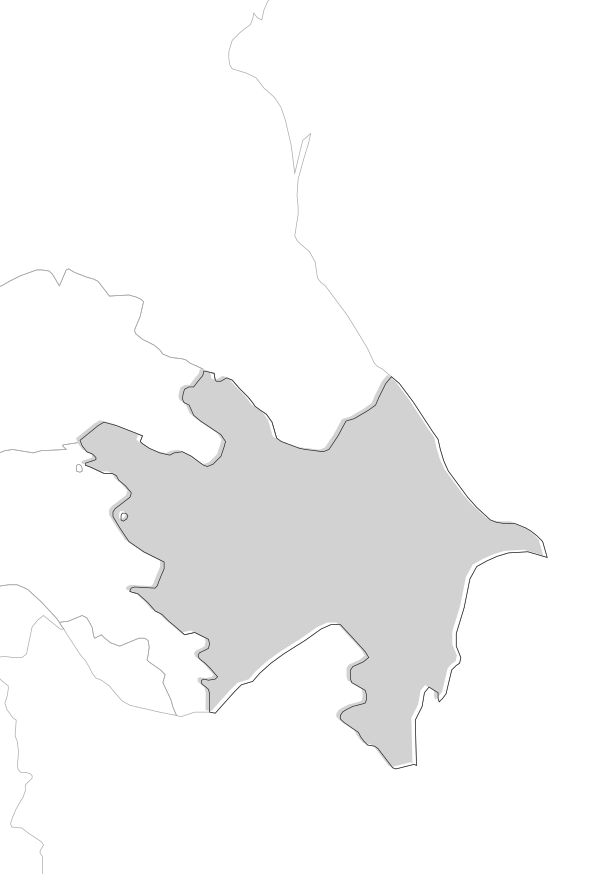
Azerbaijan
Indicator scores
The Constitution of Azerbaijan (1995, Art. 25) [68] states that all people are equal with respect to the law and that everyone has equal rights irrespective of race, ethnicity, religion, sex, origin, property status, social position, conviction, political party, trade union organisation and social unity affiliation. However, the Constitution does not mention sexual orientation, gender identity and expression, or variations in sex characteristics. No other law or regulation explicitly mentions these grounds or includes specific provisions on the implementation of the right to equality for LGBTQI persons.
There are no concrete policies or action plans to tackle homophobic, biphobic, transphobic or interphobic bullying.
The national curriculum does not include LGBTQI content. In 2015, Azerbaijan Education Ministry presented a negative statement against LGBTQI people when discussing the content of a book on language. In the book, a man has a gender-neutral name. This came into the public discussions andthe book was framed as gay propaganda. The Ministry of Education published a statement in which he said that this “was a misunderstanding. The name has no gender and author present this as men.We will never promote any values which are not acceptable and against our traditional values”.
There is currently no mandatory teacher training on LGBTQI awareness, and school staff have no specific in-service lessons or workshops.
The government provides no support to LGBTQI civil society organisations working in the area of education. GoNGO has received some funding from the Ministry of Health, while other civil society organisations report that it does not cooperate with the LGBTQI community. Gender and Development, an LGBTQI NGO has applied for registration to the Ministry of Justice since 2012, but the application has been denied without any reasons being given.
There are no clear legal or administrative proceedings to change name or gender marker. Civil society organisations report there have been some cases in which trans individuals could change theirID card after their transition, but this is based on bribe culture. Providing the individual can afford todo so, it is possible to give a bribe and get the decision from court for authorising the new ID with changes to personal information.
The government does not provide data on homophobic, biphobic, transphobic and interphobic bullying. However, local civil society organisations report specific cases that occur mostly to young boys, who do not act according to masculine stereotypes, and transgender students (see Relevant cases).
The government provides no specific support systems for LGBTQI learners or their families.
The only sources of information for LGBTQI learners are from other countries. According to the latest report published by the European Commission against Racism and Intolerance in 2016 [70],people cannot disclose their sexual orientation, gender identity or variations in sex characteristics because of social stigma, hate speech and violence, as public awareness about LGBTQI issues is very rare. LGBTQI learners who have experienced violence are, therefore, unlikely to report it.
Azerbaijan has not signed the Call for Action by Ministers – Inclusive and equitable education for all learners in an environment free from discrimination and violence.
Azerbaijan is not member of the European Governmental LGBTI Focal Points Network.
Grounds of discrimination
Here is the country's score on each ground of discrimination on which we based our observations for 8 of the 10 indicators presented above.
Country score evolution
To enable a meaningful comparison of country progress over time, we have retroactively aligned the scoring systems used in the 2018 and 2022 Editions of IGLYO’s LGBTQI Inclusive Education Index with the updated 2025 scoring criteria.
While each edition of the research has built on the previous one, reflecting evolving standards and priorities in inclusive education, minor changes to indicators and scoring weights were introduced in 2022 and 2025 to improve clarity, consistency, and comprehensiveness.
By recalculating the earlier scores according to the 2025 framework, we have tried to ensure comparability across all three editions and provide a more accurate picture of progress, stagnation, or regression in each country’s approach to LGBTQI-inclusive education.
For this reason, you might find some scores in the PDF Report & Index 2018 and 2022 differing from those on the Education website for these two years.